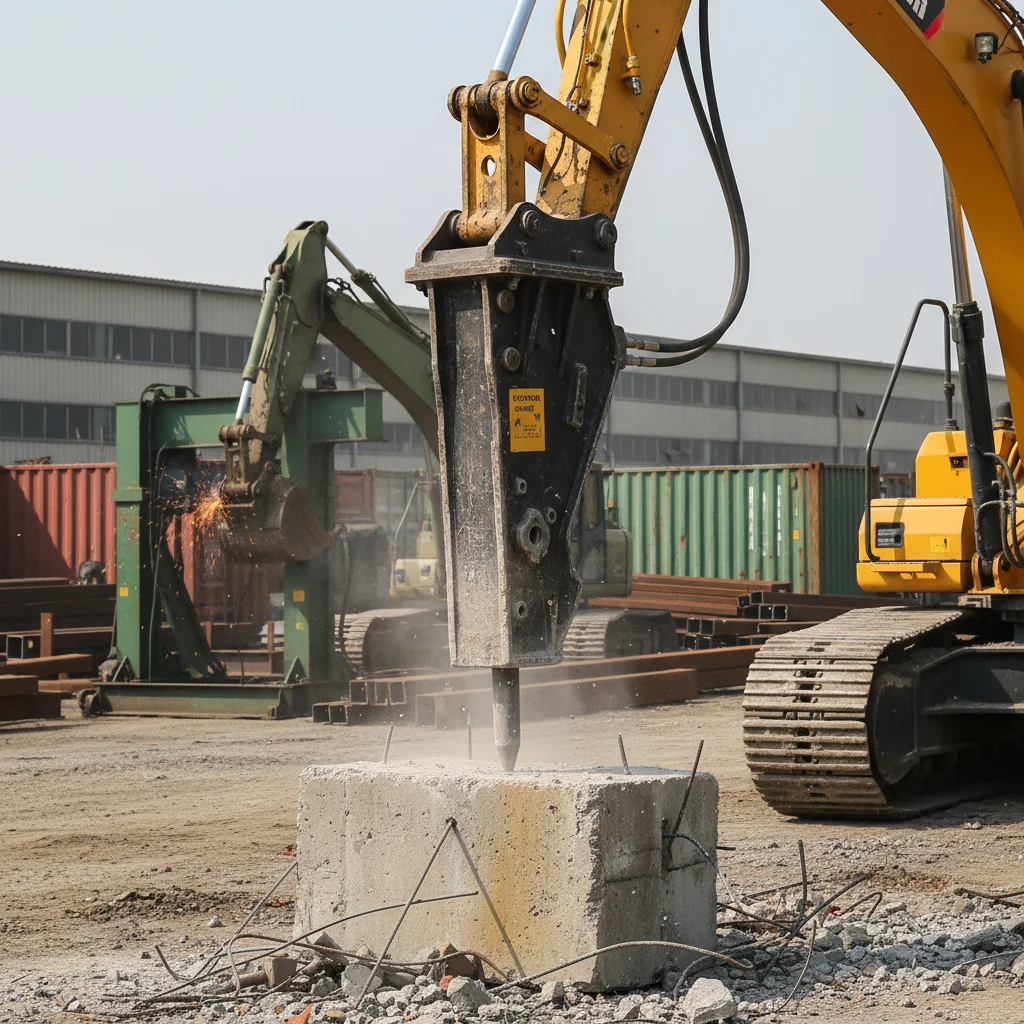
The modern construction and demolition landscape demands versatility and raw power, making the breaker attachment for excavator an indispensable tool for contractors worldwide. By transforming a standard digging machine into a high-impact demolition powerhouse, these attachments allow for the efficient breaking of concrete, asphalt, and hard rock, significantly reducing the reliance on manual labor and hazardous blasting techniques.
From an industrial perspective, the integration of a high-quality hydraulic breaker streamlines project timelines and reduces operational overhead. Whether it is urban redevelopment in densely populated cities or large-scale quarrying in remote regions, the ability to switch between a bucket and a breaker ensures that a single piece of machinery can handle multiple phases of a project, from primary demolition to final debris removal.
Understanding the technical nuances of the breaker attachment for excavator—ranging from impact energy and piston stroke to mounting compatibility—is crucial for maximizing ROI. This guide explores the global context, core engineering components, and future innovations that define the current state of hydraulic breaking technology in the heavy machinery sector.

Global Industry Context of Hydraulic Breakers
The global demand for infrastructure development, driven by rapid urbanization in Asia and Africa and the modernization of aging bridges and roads in North America and Europe, has placed a premium on demolition efficiency. According to industry trends aligned with ISO machinery standards, the shift toward "smart" construction has led to a surge in the adoption of specialized attachments. The breaker attachment for excavator solves the critical challenge of breaking high-strength materials without damaging the surrounding structural integrity.
As the World Bank highlights the need for sustainable urban growth, the ability to recycle concrete on-site has become a priority. Hydraulic breakers facilitate this by breaking down massive slabs into manageable sizes for crushing and reuse. This transition from "waste" to "resource" is only possible through the precise application of high-impact force provided by professional-grade excavator breakers.
Defining the Breaker Attachment for Excavator
In simple terms, a breaker attachment for excavator is a powerful hydraulic percussion tool that uses the excavator's own hydraulic system to drive a chisel into hard surfaces. Instead of the traditional digging motion of a bucket, the breaker converts hydraulic pressure into a high-velocity impact, effectively acting as a massive, machine-driven hammer that can penetrate reinforced concrete, granite, and other stubborn materials.
Beyond mere destruction, these tools are essential for humanitarian and civil needs, such as clearing debris after natural disasters or creating access roads for emergency services in remote mountainous terrains. The versatility of the attachment allows an operator to switch from bulk excavation to precision breaking in a matter of minutes, provided they have a compatible quick coupler system.
Technically, these attachments are categorized into side-type and top-type breakers, depending on how they are mounted to the arm. While the side-type is common for general demolition, the top-type (or silence-type) is often preferred for vertical breaking or urban areas where noise pollution must be minimized to comply with local municipal regulations.
Core Components and Engineering Factors
The durability of a breaker attachment for excavator starts with the quality of its alloy steel. The piston and cylinder must withstand extreme frictional heat and immense pressure without warping. High-grade forged steel, similar to that used in our premium pallet forks, is essential to ensure that the tool does not crack under the stress of repetitive high-energy impacts.
A critical factor is the "Nitrogen Chamber" management. In most modern breakers, nitrogen gas acts as a spring, accumulating energy and returning the piston to its starting position. Proper gas pressure calibration is what separates a professional-grade breaker attachment for excavator from a low-end alternative, directly impacting the blow-rate and energy transfer efficiency.
Finally, the chisel (or tool bit) is the primary point of contact. Depending on the application—whether it's moil point for general concrete or blunt for hard rock—the chisel's heat treatment determines its longevity. A failure in the tool bit's metallurgy leads to rapid wear, increasing downtime and operational costs for the end-user.
Operational Performance Metrics
When evaluating a breaker attachment for excavator, operators look at the balance between impact energy (Joules) and blow frequency (BPM). A high impact energy is required for breaking massive boulders, while a higher frequency is more effective for slicing through reinforced concrete or asphalt.
The synergy between the excavator's hydraulic flow and the breaker's requirements is the most vital technical metric. Over-pressurizing a breaker can lead to seal failure, while under-pressurizing results in weak impacts, making the job take twice as long and wasting fuel.
Performance Comparison of Breaker Attachment for Excavator Types
Global Applications and Use Cases
In the mining sector of regions like Australia and Brazil, the heavy-duty breaker attachment for excavator is used for secondary breaking. After primary blasting, oversized boulders often block the crusher; the hydraulic breaker is deployed to reduce these rocks to a size that can be safely processed, ensuring the mine's production flow remains uninterrupted.
Conversely, in urban centers like Tokyo or New York, "silenced" breaker attachments are the industry standard. These units utilize a sound-dampening housing that reduces decibel levels, allowing demolition to occur in residential areas without violating noise ordinances. In post-disaster relief, such as after earthquakes, these tools are used to carefully penetrate collapsed structures to rescue survivors without causing further instability.
Long-Term Value and Sustainability
The long-term value of investing in a premium breaker attachment for excavator lies in the reduction of "cost per ton" of material broken. While cheaper alternatives may seem attractive, they often suffer from premature seal wear and piston scoring, leading to expensive downtime. A high-quality breaker ensures a predictable lifecycle and lower maintenance intervals.
From a sustainability angle, hydraulic breakers promote the "Circular Economy." By enabling the precise demolition of concrete structures, they allow for the segregation of rebar from concrete on-site. This separates the steel for smelting and the concrete for aggregate, significantly reducing the carbon footprint associated with transporting waste to landfills and quarrying new raw materials.
Safety is the most profound emotional and logical benefit. Using a machine-mounted breaker removes the worker from the "danger zone" of flying debris and the physical strain of manual hammering. This shift in operational methodology preserves the dignity and health of the workforce, fostering a safer, more innovative construction environment.
Future Trends and Technological Innovations
The next frontier for the breaker attachment for excavator is the integration of "Auto-Stop" technology. Using sensors to detect when the chisel has penetrated the material, the system can automatically stop the hammering action. This prevents "blank firing," which is the leading cause of internal damage and unnecessary wear on the piston and bushings.
Digital transformation is also arriving in the form of IoT-enabled monitoring. Future breakers will transmit real-time data on temperature, hit count, and gas pressure to the operator's cabin. This allows for predictive maintenance, where a technician can replace a seal before it fails, rather than reacting to a breakdown in the middle of a critical project.
Furthermore, as the industry moves toward electric excavators, we are seeing the development of electro-hydraulic breakers that are more energy-efficient and produce zero local emissions. This evolution aligns with global green energy policies and the demand for "zero-emission" construction sites in European smart cities.
Comparative Analysis of Breaker Attachment Technologies
| Technology Type |
Impact Efficiency |
Noise Level |
Maintenance Need |
| Standard Hydraulic |
High (8/10) |
Loud (9/10) |
Moderate |
| Silence-Type Box |
Medium (7/10) |
Low (4/10) |
Low |
| Electro-Hydraulic |
High (9/10) |
Medium (6/10) |
Complex |
| Pneumatic-Hybrid |
Medium (6/10) |
High (8/10) |
High |
| Auto-Stop Smart |
Max (10/10) |
Medium (6/10) |
Very Low |
| Heavy Duty Rock |
Ultra (10/10) |
Very Loud (10/10) |
Moderate |
FAQS
The choice depends primarily on the excavator's operating weight and hydraulic flow rate. Using a breaker that is too large can strain the hydraulic pump and cause stability issues, while one that is too small will lack the impact energy needed for the material. Always match the breaker's required flow (L/min) and pressure (bar) with your machine's specifications to ensure optimal performance and prevent premature failure.
Blank firing occurs when the piston strikes the tool bit without the bit being pressed firmly against a hard surface. This sends the massive impact energy back into the internal components of the breaker rather than into the rock. Over time, this can crack the tie-rods, damage the piston, and destroy the seals. We recommend using breakers with "auto-stop" features to eliminate this risk.
Greasing is critical to prevent friction and overheating. As a general rule, the tool bit should be greased every 2 hours of continuous operation. Using high-temperature, molybdenum-disulfide grease is recommended, as it provides a protective layer that withstands the extreme heat generated by the percussion process, extending the life of both the chisel and the bushings.
Yes, provided you have the correct mounting bracket or a universal quick coupler. While most breakers are designed to be brand-agnostic, the hydraulic connections may vary. Adapters are often used to match the breaker's hose fittings to the excavator's auxiliary hydraulic lines. Always verify that your machine's hydraulic oil quality meets the breaker manufacturer's requirements.
A moil point is pointed and designed for general-purpose demolition, such as breaking concrete or soft rock, as it concentrates energy on a single point. A blunt (or wedge) chisel is designed for hard rock and quarrying, as it creates a cracking effect along natural fault lines in the stone. Choosing the wrong chisel can lead to faster wear and lower breaking efficiency.
Nitrogen gas acts as an accumulator; it stores energy and pushes the piston back up for the next strike. If the gas pressure is too low, the blow rate drops and the impact energy decreases significantly. If it is too high, it can cause excessive wear on the internal seals. Regular pressure checks with a specialized gauge are essential for maintaining peak performance.
Conclusion
The breaker attachment for excavator is more than just a demolition tool; it is a strategic asset that enhances the versatility, safety, and profitability of any construction fleet. By integrating high-grade materials, precise hydraulic engineering, and sustainable practices, these attachments allow operators to tackle the toughest materials while minimizing environmental impact and operational costs.
As we look toward a future of automation and electric machinery, the role of the hydraulic breaker will only grow in importance. We suggest that contractors prioritize investments in "smart" breakers with auto-stop technology and IoT monitoring to ensure long-term reliability. For those seeking professional-grade attachments that balance power with durability, explore our full range of solutions at our website: www.crafts-mfg.com.