
- afrikaans
- albanian
- amharic
- arabic
- armenian
- assamese
- aymara
- azerbaijani
- bambara
- basque
- belarusian
- bengali
- bhojpuri
- bosnian
- bulgarian
- burmese
- catalan
- cebuano
- corsican
- creole
- croatian
- czech
- danish
- deutsch
- dhivehi
- dogrid
- dutch
- english
- estonian
- ewe
- filipino
- finnish
- french
- frisian
- galician
- georgian
- greek
- guarani
- gujarati
- haitian_creole
- hausa
- hawaiian
- hebrew
- hindi
- hungarian
- icelandic
- igbo
- indonesian
- irish
- italian
- japanese
- kannada
- khmer
- kinyarwanda
- korean
- kurdish
- kurdish_sorani
- kyrgyz
- lao
- latin
- latvian
- lithuanian
- luganda
- luxembourgish
- macedonian
- maithili
- malay
- malayalam
- maltese
- maori
- marathi
- nepali
- norwegian
- nyanja
- oromo
- pashto
- persian
- polish
- portuguese
- punjabi
- quechua
- romanian
- russian
- samoan
- sanskrit
- scottish_gaelic
- shona
- sindhi
- singapore
- slovak
- slovene
- somali
- spanish
- swahili
- swedish
- tajik
- tamil
- tatar
- telugu
- thai
- turkish
- turkmen
- twi
- ukrainian
- urdu
- vietnamese
- welsh
- yiddish
- yoruba
In the demanding world of heavy construction and earthmoving, the versatility of a machine is defined not by its engine power alone, but by the tools it carries. High-quality excavator attachments transform a standard digging machine into a multi-purpose powerhouse, capable of everything from precision grading to heavy-duty demolition. For contractors and fleet managers, investing in the right toolset means reducing downtime and eliminating the need for multiple specialized machines on a single job site.
Globally, the shift toward modular construction and rapid urban development has increased the reliance on diverse end-of-arm tooling. Whether it is a hydraulic breaker for breaking concrete or a grapple for forestry work, these attachments allow operators to adapt to changing soil conditions and project requirements in real-time. This adaptability is no longer a luxury but a competitive necessity in an industry where labor costs are rising and project timelines are shrinking.
Understanding the technical nuances of these tools—such as hydraulic flow requirements, material hardness, and coupling compatibility—is essential for maximizing equipment lifespan. By selecting the correct excavator attachments, companies can significantly improve their operational efficiency, ensure operator safety, and lower the total cost of ownership across their heavy machinery fleet.

Global Industry Context of Excavator Attachments
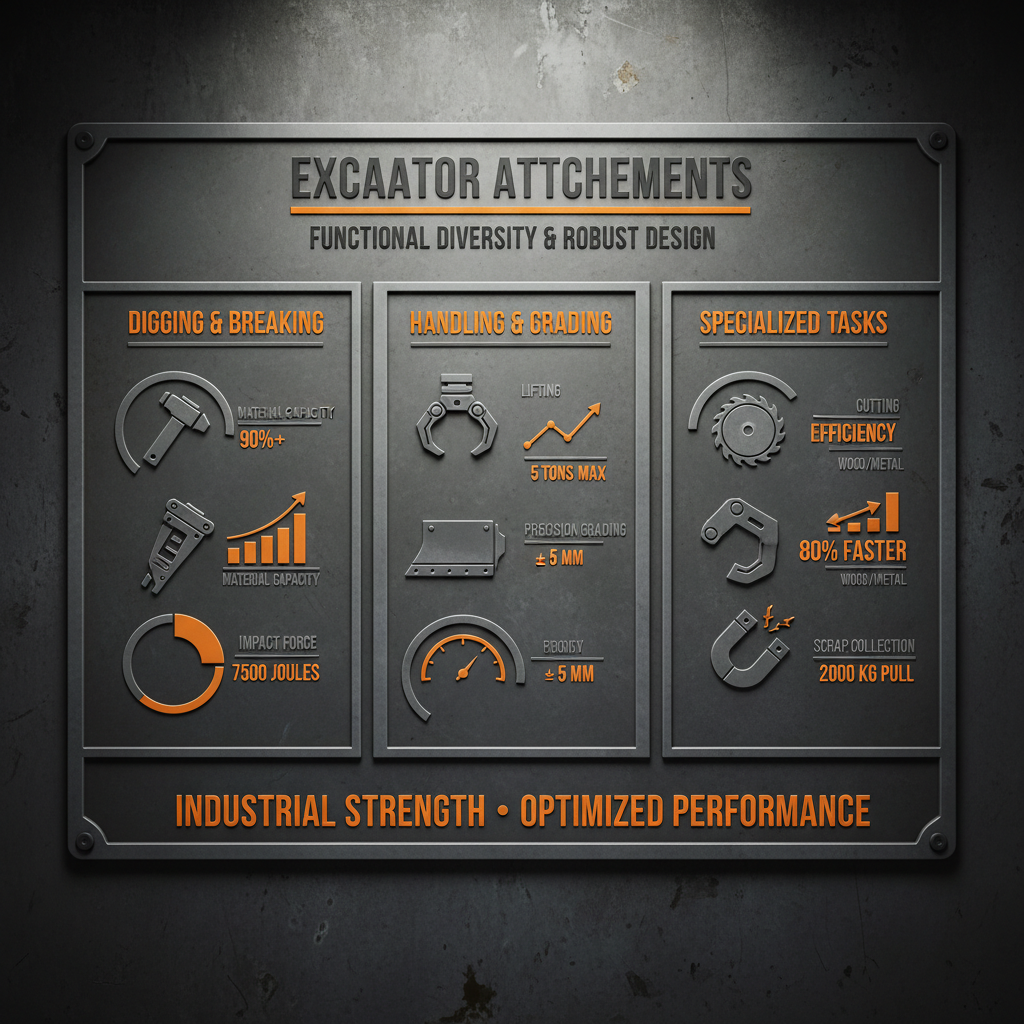
The global construction machinery market is currently navigating a period of intense transformation. According to industry data mirroring ISO standards for earthmoving equipment, there is a marked increase in the demand for "multi-tool" capability. In regions like North America and Southeast Asia, the pressure to execute infrastructure projects with fewer machines has pushed excavator attachments from the periphery to the center of procurement strategies.
The primary challenge facing the industry is the inefficiency of traditional "single-purpose" fleets. Transporting five different machines to a site increases logistics costs and carbon emissions. By integrating a variety of attachments—such as tilt buckets, hydraulic thumbs, and pulverizers—operators can solve complex site problems without the overhead of additional heavy haulage, directly impacting the bottom line of large-scale civil engineering projects.
FAQS
Choosing the right attachment requires matching the tool's hydraulic requirements (flow and pressure) with your excavator's auxiliary hydraulic system. Additionally, consider the material you are working with—rock, soil, or demolition debris—to decide between a standard, rock, or skeleton bucket. Always verify the coupling system to ensure the tool can be swapped quickly and safely.
Yes, for high-intensity sites. Hydraulic couplers allow the operator to switch excavator attachments from inside the cab, which eliminates the time spent climbing in and out and significantly improves safety by keeping personnel away from the machine's linkage. The labor savings usually offset the higher initial cost within a few months of heavy use.
Maintenance schedules vary, but generally, pivot points and grease nipples should be serviced every 8-10 hours of operation. For high-impact tools like hydraulic breakers, daily inspections of the tool steel and diaphragm are recommended. Regularly checking for hydraulic leaks at the connection points is essential to prevent pressure loss and environmental contamination.
Generally, yes, provided they share the same coupling standard (e.g., ISO or brand-specific patterns). However, it is critical to ensure the hydraulic fittings are compatible. Using adapters can work, but it may introduce slight pressure drops. We recommend verifying the pin diameter and spacing to avoid excessive "slop" or play in the connection, which can lead to premature wear.
A standard bucket is designed for maximum volume and digging power. A grading bucket has a wider, flatter bottom and often a different angle of attack, allowing the operator to "shave" the ground to a smooth, level finish. Many grading buckets now feature tilt-rotator technology, enabling the operator to angle the bucket without moving the entire machine.
The best way to extend lifespan is to avoid "sideways" loading or using the bucket to push heavy loads horizontally. Regularly inspect the teeth for excessive wear and replace them before they wear down to the adapter. Using high-grade tungsten carbide tips in highly abrasive environments can also significantly reduce the frequency of replacements.
Conclusion
In summary, excavator attachments are the primary drivers of versatility and efficiency in modern construction and mining. By transitioning from a single-purpose machine to a modular platform, contractors can reduce capital expenditure, lower their environmental impact, and increase their capacity to handle diverse project requirements. From the durability of wear-resistant steels to the precision of IoT-enabled smart tools, the right attachment transforms an excavator into a truly indispensable asset.
Looking ahead, the integration of automation and green energy will continue to push the boundaries of what is possible on the job site. We suggest that fleet managers prioritize the adoption of quick couplers and high-tensile tooling to remain competitive in an increasingly fast-paced market. For those looking to optimize their operations with industry-leading tools, visit our website: www.crafts-mfg.com to explore our comprehensive range of professional solutions.
Related Posts
-
Comprehensive Guide to Hydraulic Hammer for Excavator for Sale and Applications
-
Find High Quality Excavator Shear for Sale and Optimize Your Operations
-
Optimizing Heavy Machinery Performance with Durable Replacement Rubber Tracks
-
Durable Rubber Track Pads Manufacturer for Heavy Equipment Performance