0%

Table of Contents

In the demanding world of heavy construction and earthmoving, the versatility of a machine is defined not by its engine power alone, but by the tools it carries. High-quality excavator attachments transform a standard digging machine into a multi-purpose powerhouse, capable of everything from precision grading to heavy-duty demolition. For contractors and fleet managers, investing in the right toolset means reducing downtime and eliminating the need for multiple specialized machines on a single job site.

Globally, the shift toward modular construction and rapid urban development has increased the reliance on diverse end-of-arm tooling. Whether it is a hydraulic breaker for breaking concrete or a grapple for forestry work, these attachments allow operators to adapt to changing soil conditions and project requirements in real-time. This adaptability is no longer a luxury but a competitive necessity in an industry where labor costs are rising and project timelines are shrinking.

Understanding the technical nuances of these tools—such as hydraulic flow requirements, material hardness, and coupling compatibility—is essential for maximizing equipment lifespan. By selecting the correct excavator attachments, companies can significantly improve their operational efficiency, ensure operator safety, and lower the total cost of ownership across their heavy machinery fleet.

excavator attachments

Global Industry Context of Excavator Attachments
excavator attachments

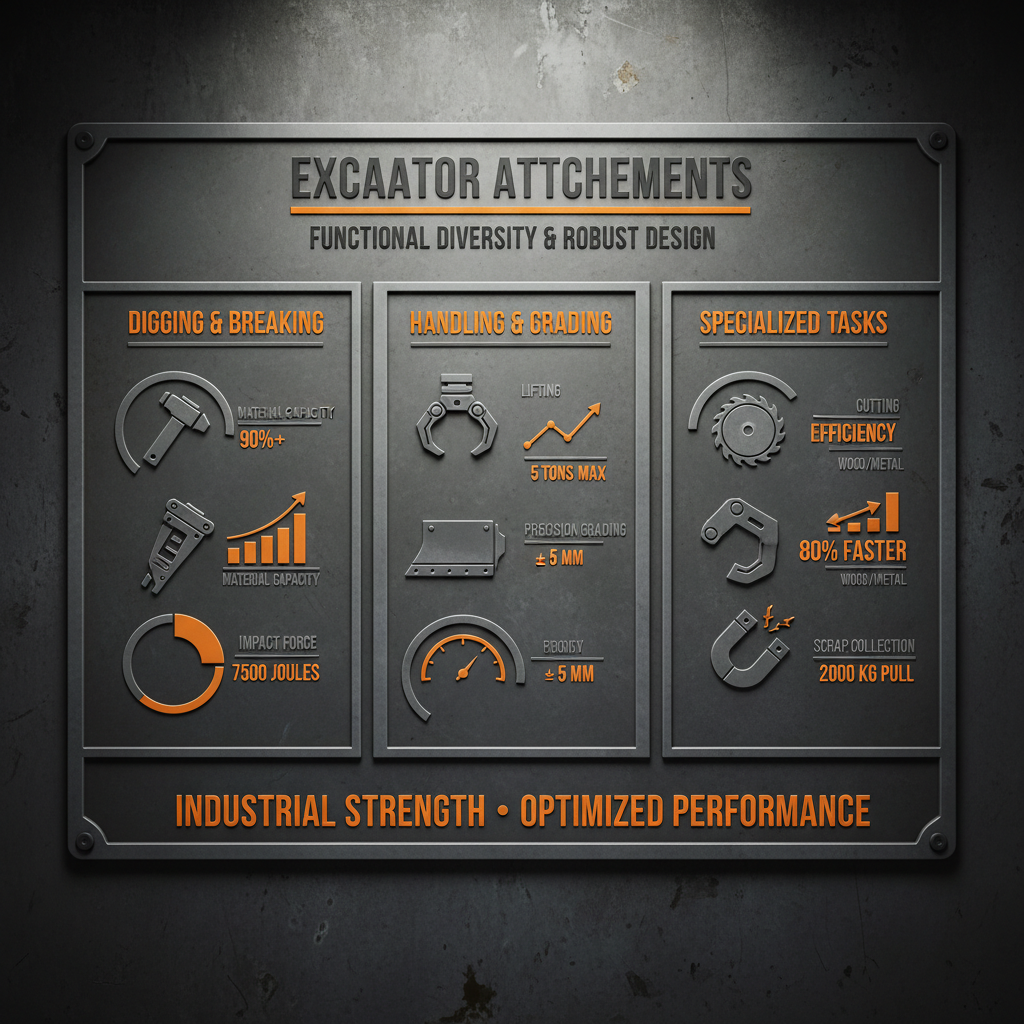
The global construction machinery market is currently navigating a period of intense transformation. According to industry data mirroring ISO standards for earthmoving equipment, there is a marked increase in the demand for "multi-tool" capability. In regions like North America and Southeast Asia, the pressure to execute infrastructure projects with fewer machines has pushed excavator attachments from the periphery to the center of procurement strategies.

The primary challenge facing the industry is the inefficiency of traditional "single-purpose" fleets. Transporting five different machines to a site increases logistics costs and carbon emissions. By integrating a variety of attachments—such as tilt buckets, hydraulic thumbs, and pulverizers—operators can solve complex site problems without the overhead of additional heavy haulage, directly impacting the bottom line of large-scale civil engineering projects.

Defining Modern Excavator Attachments

In simple technical terms, excavator attachments are specialized tools that are connected to the end of an excavator's arm (the stick) to perform tasks beyond basic digging. While the standard bucket is the most common, the "attachment" category encompasses a wide range of hydraulic, mechanical, and pneumatic tools. These include everything from G.E.T. (Ground Engaging Tools) parts to complex rotary screening buckets that sort materials on the fly.

From an industrial perspective, these tools represent the "hands" of the machine. Just as a human uses different tools for different tasks, the modern excavator utilizes excavator attachments to pivot between demolition, landscaping, dredging, and road maintenance. This modularity is essential for urban humanitarian needs, such as rapid debris removal after natural disasters, where time is the most critical variable.

The connection between the machine and the attachment is typically managed via a quick coupler—either mechanical or hydraulic. This interface is the critical point of failure or success; a high-quality coupler ensures that the tool remains secure under extreme loads while allowing the operator to switch tools in seconds without leaving the cab, thereby maintaining a high rhythm of productivity.

Core Components for Maximum Performance

Durability is the cornerstone of any high-performance tool. For excavator attachments, this means using high-tensile alloy steels and heat-treatment processes that prevent premature wear in abrasive environments. The use of Hardox or similar wear-resistant plates ensures that buckets and grapples can withstand the friction of rock and concrete without requiring frequent welding repairs.

Hydraulic Efficiency and Compatibility are equally vital. An attachment is only as good as the power it receives from the carrier. Ensuring that the hydraulic flow (L/min) and pressure (bar) of the excavator align with the requirements of the attachment—such as a hydraulic breaker or a rotary grapple—prevents overheating and optimizes the cycle time of the operation.

Scalability and Versatility allow a fleet to grow without exponential cost increases. By investing in a range of compatible excavator attachments, such as switching from a standard bucket to a skeleton bucket for sorting or a grading bucket for finishing, a company can bid on a wider variety of contracts, from heavy quarrying to precise residential landscaping.

Global Applications and Use Cases

Across the globe, the application of specialized tooling varies by regional industrial needs. In the mining sectors of Australia and Canada, heavy-duty rock buckets and rippers are indispensable for breaking through frozen or basaltic ground. Meanwhile, in the densely populated cities of Europe, concrete pulverizers and demolition booms are used to dismantle structures within tight confines, minimizing the impact on surrounding urban infrastructure.

In post-disaster relief operations, such as those managed by international NGOs, the use of hydraulic grapples and thumbs is critical for clearing unstable debris safely. These excavator attachments allow operators to grip and move large, irregular objects—like fallen beams or concrete slabs—with precision, reducing the risk to ground personnel and speeding up the recovery of critical access roads.

Efficiency Ratings of Various Excavator Attachments

Long-Term Value and Operational Advantages

The tangible benefit of utilizing a diverse array of excavator attachments is a drastic reduction in capital expenditure. Instead of purchasing a dedicated compactor, a breaker, and a loader, a firm can purchase one high-quality excavator and the corresponding attachments. This logic extends to sustainability; fewer machines mean less fuel consumption during transport and a smaller carbon footprint for the overall project.

Beyond the numbers, there is a significant human element: safety and dignity. Tools like hydraulic thumbs and remote-controlled demolition arms remove the operator and ground crew from the "danger zone." By reducing the need for manual labor in hazardous environments, these attachments foster a culture of innovation and trust, where the focus shifts from brute force to engineering precision.

Future Trends in Attachment Technology

The future of excavator attachments is being shaped by the digital transformation of the construction site. We are seeing the rise of "smart attachments" equipped with integrated sensors that provide real-time data on load weight, tilt angle, and wear levels. These IoT-enabled tools allow fleet managers to predict maintenance needs before a failure occurs, shifting from reactive to proactive upkeep.

Automation and GPS integration are also redefining precision. Modern grading buckets are now being paired with 3D machine control systems, allowing the attachment to automatically adjust its angle to match a digital site plan. This eliminates the need for constant manual staking and surveying, reducing human error and ensuring that the final grade is perfect on the first pass.

Furthermore, the push toward green energy is influencing material science. The development of lighter, ultra-high-strength alloys reduces the energy required to move the attachment, while the integration of electric-hydraulic systems in smaller attachments reduces noise pollution—a critical factor for urban "silent" construction zones in cities like Tokyo or London.

Common Challenges and Expert Solutions

One of the most persistent challenges is "hydraulic mismatch," where an attachment is paired with a machine that cannot provide sufficient flow or pressure. This leads to sluggish performance and accelerated wear on the hydraulic pumps. The expert solution is the implementation of a rigorous compatibility audit before procurement, ensuring that the carrier's auxiliary hydraulics are rated for the specific tool's demands.

Another common issue is the rapid wear of G.E.T. parts in highly abrasive soils. Many operators overlook the importance of regular rotation and replacement of teeth and adapters. To overcome this, leading firms are adopting "wear-mapping" schedules, where attachments are inspected every 250 operating hours to replace components before they compromise the structural integrity of the bucket.

Finally, the complexity of switching between multiple excavator attachments can lead to operational delays. Transitioning to fully hydraulic quick couplers allows for seamless tool changes without the operator leaving the cab. This not only saves time but also enhances safety by keeping the operator away from heavy moving parts during the changeover process.

Comparative Analysis of Attachment Performance and Costs

Attachment Type Durability Score (1-10) Maintenance Frequency ROI Period
Hydraulic Breaker 8 Moderate (Greasing) 6-12 Months
Rock Bucket 10 Low (Tooth Replace) 3-6 Months
Rotary Grapple 7 High (Pivot Points) 12-18 Months
Tilt Quick Coupler 9 Low (Inspection) 4-8 Months
Concrete Pulverizer 8 Moderate (Pin Wear) 9-15 Months
Skeleton Bucket 9 Low (Cleaning) 5-10 Months

FAQS

How do I choose the right excavator attachments for my machine?

Choosing the right attachment requires matching the tool's hydraulic requirements (flow and pressure) with your excavator's auxiliary hydraulic system. Additionally, consider the material you are working with—rock, soil, or demolition debris—to decide between a standard, rock, or skeleton bucket. Always verify the coupling system to ensure the tool can be swapped quickly and safely.

Are hydraulic quick couplers worth the investment over mechanical ones?

Yes, for high-intensity sites. Hydraulic couplers allow the operator to switch excavator attachments from inside the cab, which eliminates the time spent climbing in and out and significantly improves safety by keeping personnel away from the machine's linkage. The labor savings usually offset the higher initial cost within a few months of heavy use.

How often should I maintain my hydraulic attachments?

Maintenance schedules vary, but generally, pivot points and grease nipples should be serviced every 8-10 hours of operation. For high-impact tools like hydraulic breakers, daily inspections of the tool steel and diaphragm are recommended. Regularly checking for hydraulic leaks at the connection points is essential to prevent pressure loss and environmental contamination.

Can I use attachments from different brands on one excavator?

Generally, yes, provided they share the same coupling standard (e.g., ISO or brand-specific patterns). However, it is critical to ensure the hydraulic fittings are compatible. Using adapters can work, but it may introduce slight pressure drops. We recommend verifying the pin diameter and spacing to avoid excessive "slop" or play in the connection, which can lead to premature wear.

What is the difference between a grading bucket and a standard bucket?

A standard bucket is designed for maximum volume and digging power. A grading bucket has a wider, flatter bottom and often a different angle of attack, allowing the operator to "shave" the ground to a smooth, level finish. Many grading buckets now feature tilt-rotator technology, enabling the operator to angle the bucket without moving the entire machine.

How do I extend the lifespan of my bucket teeth and G.E.T. parts?

The best way to extend lifespan is to avoid "sideways" loading or using the bucket to push heavy loads horizontally. Regularly inspect the teeth for excessive wear and replace them before they wear down to the adapter. Using high-grade tungsten carbide tips in highly abrasive environments can also significantly reduce the frequency of replacements.

Conclusion

In summary, excavator attachments are the primary drivers of versatility and efficiency in modern construction and mining. By transitioning from a single-purpose machine to a modular platform, contractors can reduce capital expenditure, lower their environmental impact, and increase their capacity to handle diverse project requirements. From the durability of wear-resistant steels to the precision of IoT-enabled smart tools, the right attachment transforms an excavator into a truly indispensable asset.

Looking ahead, the integration of automation and green energy will continue to push the boundaries of what is possible on the job site. We suggest that fleet managers prioritize the adoption of quick couplers and high-tensile tooling to remain competitive in an increasingly fast-paced market. For those looking to optimize their operations with industry-leading tools, visit our website: www.crafts-mfg.com to explore our comprehensive range of professional solutions.

Kevin Davis

Kevin Davis

Kevin Davis is the Supply Chain Manager for North America at Xuzhou Crafts Machinery Equipment Co., Ltd. He oversees the logistics and distribution network, ensuring timely delivery of parts and attachments to customers across the US and Canada. Kevin’s expertise lies in optimizing the supply chain process, from sourcing materials to managing inventory. He’s instrumental in coordinating with our alliance of Chinese factories to provide a wide range of spare parts for road pavement construction machines. Kevin has over 10 years of experience in supply chain management within the manufacturing industry and is dedicated to efficiency and cost-effectiveness.
Previous Benefits of adding hydraulic thumb to excavator for construction

If you are interested in our products, you can choose to leave your information here, and we will be in touch with you shortly.

  • captcha